Introducing...
OOBLECK!

(To see the mock-movie lesson preview video, check out the post on 2/28/12.)
For this project, Ms. Hanson, our librarian began by reading "Bartholomew and the Oobleck" by Dr. Seuss.

Through the book discussion, we realized the importance of saying you're sorry when you make a mistake. An apology can cure many ills.
After discussing the book, we made some Oobleck of our own. The mixture is two parts cornstarch and one part water. Oobleck has an interesting consistency. Try to punch it, and it is hard like a brick wall; But just lightly place a finger on its surface, and your hand will sink right in. So, Is it a solid or a liquid, you ask?
...Well, Oobleck is a non-newtonian fluid. Non-Newtonian fluids are a strange and perplexing group of fluids. When a force (ex. poking, rolling, stirring, punching) is applied to a non-Newtonian fluid, the viscosity (or, resistance to flow) of the fluid increases. In simple terms, any force you exert on a non-Newtonian fluid will make it behave more like a solid. The more force you exert, the harder the fluid becomes. Strange, but true! Other types of non-Newtonian fluids include quicksand, ketchup, and peanut butter.So what happens when different types of force are applied to Oobleck? Will it resist all types of force? Which is more powerful against Oobleck: the force of gravity or the frequency of sound waves? These are all questions that needed answers.
 Good thing our music teacher, Mr. Dodd, was there to help!
 When we applied sound waves to Oobleck, it began to rise and dance to the force of the frequencies! The sound waves must be more influential than gravity on Oobleck.
 Interestingly, we discovered that lower frequencies (the sounds of an explosion or bass in a song) subjected the Oobleck to much more movement.
...Now, for Mrs. Kingsolver's favorite part! 

COLOR!
Last semester, students Kindergarten-3rd grade made artwork using primary colors to create secondary colors. We had so much using our color mixing skills to make the Oobleck a work of art!
We started with primary colors...
 Turned on the sound waves...
 We watched as Blue and Red danced together...
 to become Purple!
 Blue and Yellow mixed into Green!
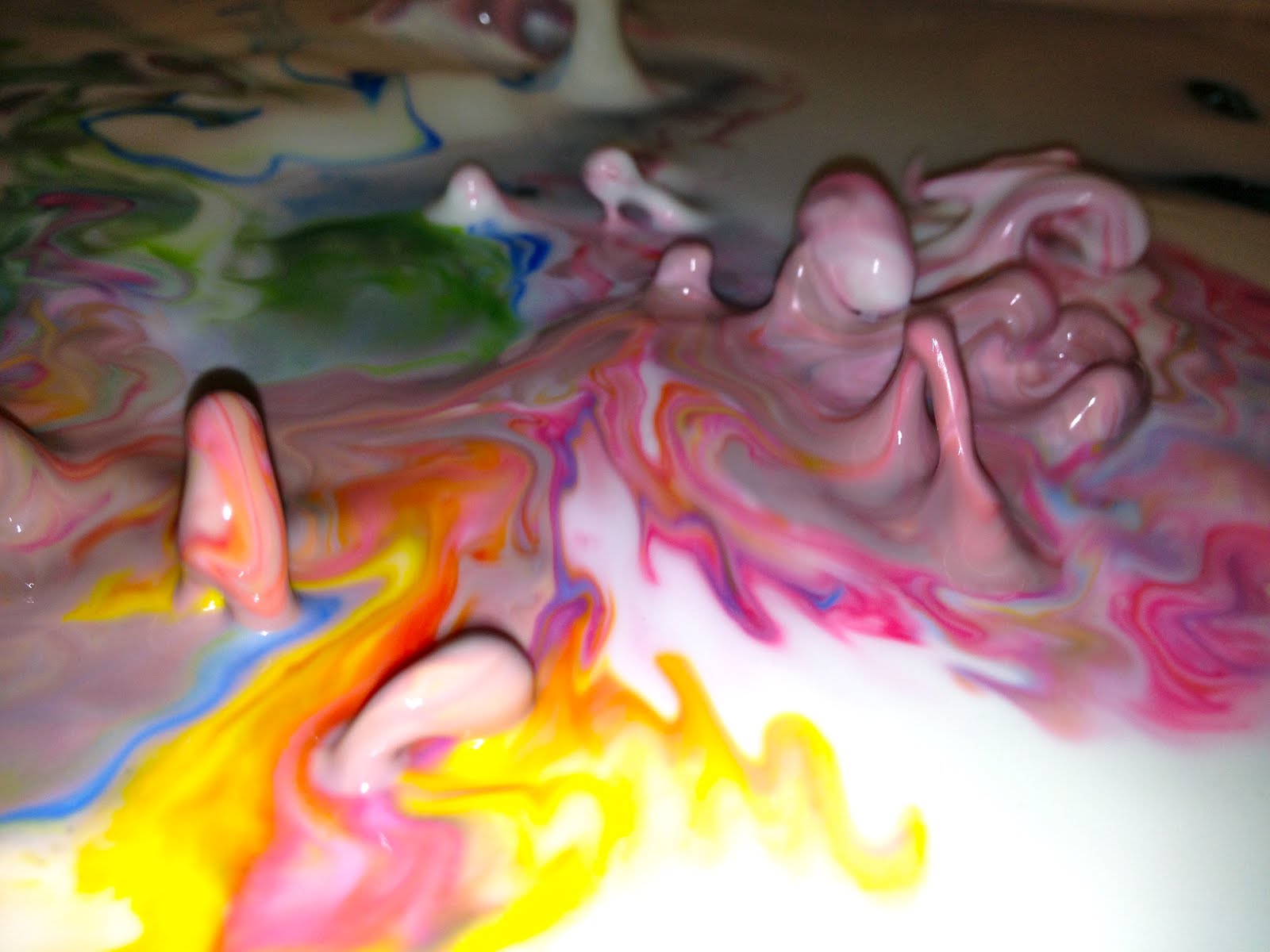 And Yellow and Red became Orange!
 By the time we were finished our Oobleck art in motion, we had created a beautiful color palette that looked strikingly similar to marbled paper.
We hope you enjoyed out Art/Music/Science/Language Arts project!!


